
Helping Vulnerable African Children
Vision to Reality
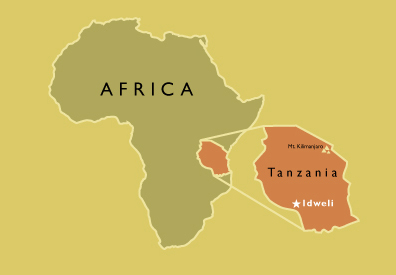
HIV/AIDS has killed millions of people in sub-Saharan Africa and has left over 13 million orphans. Some are taken in by relatives. Many are not. Born poor, these children lack the basic necessities of everyday life. With vision, leadership and well-targeted resources, their lives can change. The vision behind our story begins with Godfrey Mahenge, a medical student who planned to return to his village, Idweli, to care for its nearly 250 AIDS orphans. Tragically, Godfrey died in an accident before he could realize his dream. His friends and relatives took up the cause, and teamed up several non-profits, including the Lundy Foundation and a local Tanzanian nonprofit named after Godfrey.
The approach taken was unique.
Working together, the partnership began by asking the children to describe the greatest problems facing them in their daily lives. Drawing pictures to depict their thoughts, the children identified the loss of parents and other family members to HIV/AIDS. They envisioned a center where orphaned children could be sheltered and fed. In 2005 Godfrey’s Children Center was born from the children’s dreams. In partnership with the Rockefeller Foundation, we convened a team of evaluation experts who designed and implemented a rigorous research program to measure the impact of the Children’s Center on the village’s orphaned and vulnerable children’s well-being. We have piloted a research methodology that can be used by other private and governmental entities working to improve the well-being of children worldwide. In addition, we advocated in Washington, D.C. for legislation that would require recipients of U.S. foreign aid to evaluate the impacts of the programs funded so we can determine whether America’s generosity is achieving the desired goals.
Godfrey’s Children Center
Godfrey’s Children Center was a haven for children in need and a hub of activity in an isolated village hard-hit by the HIV/AIDS pandemic. The center’s five buildings were constructed by villagers who used a single hand-operated machine to make 10,000 bricks. Unfortunately, due to a conflict between a foreign donor, the community of Idweli and Godfrey’s Children Organization (Tanzania NGO), the center was closed by the Tanzanian district government in December 2007.
The Lundy Foundation regretted the closing of Godfrey’s Children Center, but we were able to take the valuable lessons learned there and leverage them. Our experience in evaluating the center’s impact, for example, has evolved into a research methodology that can be used internationally by any organization seeking to improve children’s lives. Further, we have come to believe that all international projects funded by the U.S. government can benefit from monitoring and evaluation, like we did in Idweli. We have become advocates before Congress for the passage of legislation requiring all U.S. foreign aid programs to be evaluated for impacts and results.
Godfrey’s Children Center may only be a memory, but its impact lives on.
Profile of Idweli, Tanzania
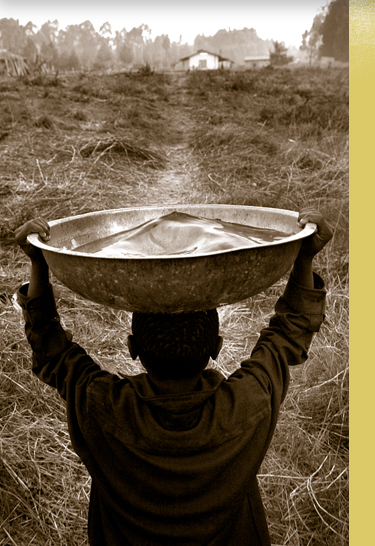
Total Population: 2,500
Adults: 2,050
Children: 450
Orphans: 290
Primary Source of Income: subsistence agriculture
Major Crops: maize, potatoes, and beans
Average Daily Income: 70¢
Biggest Problem: AIDS orphans
Photographs and Video
Building the Godfrey’s Children Center

Villagers staked out the buildings with timber and rope on the hand-leveled building site.
February 1, 2004

Villagers used a single hand-operated machine to make 10,000 bricks, then moved them by hand to the building site.
February 1, 2004
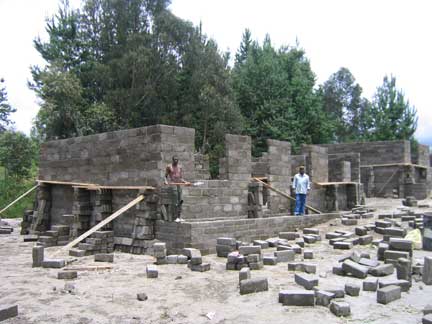
The village’s skilled laborers, working for $1.50 a day, put their hearts and hands into constructing a dormitory.
April 6, 2004
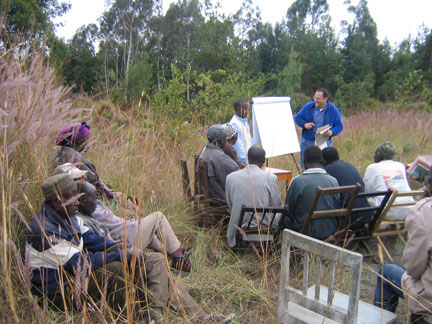
Villagers, including elders, children and local government officials, met to determine how center operations would be sustained.
June 21, 2004
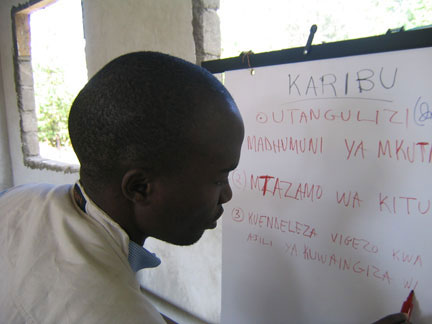
Tanzanian project manager Furaha Nsemwa facilitated a meeting to establish guidelines for determining which children most needed center services.
June 21, 2004
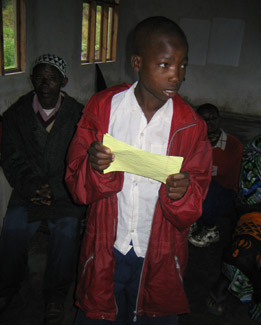
One of the children who helped create the vision for the center explained to village elders his desire to join the governing board.
December 28, 2004
Opening Ceremonies
Acting U.S. Ambassador Michael S. Owen officiated at the June 8, 2005, grand opening of Godfrey’s Children Center in Idweli, Tanzania.
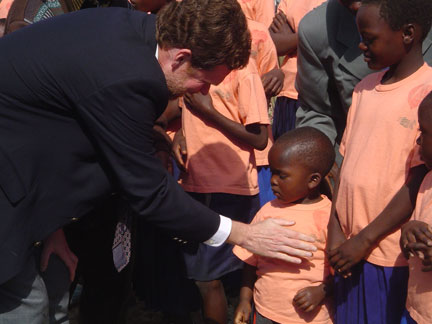
Acting U.S. Ambassador Michael S. Owen greeted one of the center’s younger residents during the opening ceremonies.
June 8, 2005
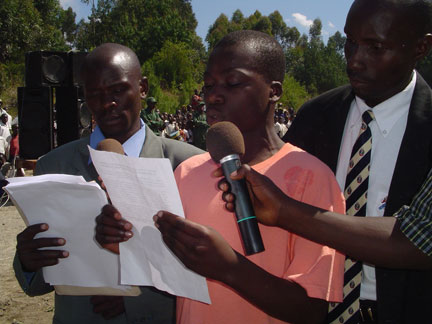
Center manager and a resident read an official pledge to study hard and help the younger center residents.
June 8, 2005
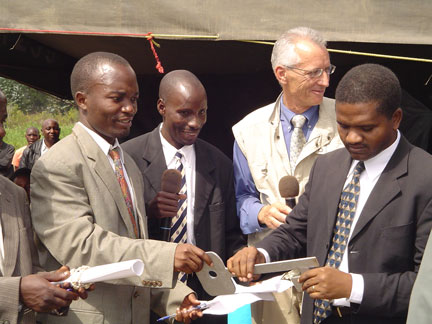
Members of Godfrey’s board accept a symbolic key designed to unlock the love waiting inside the center.
June 8, 2005
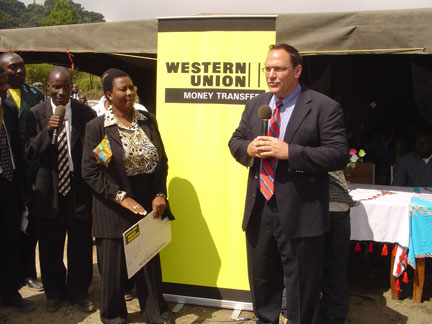
Western Union representatives thank the president of the Lundy Foundation for their support of the children’s center.
June 8, 2005
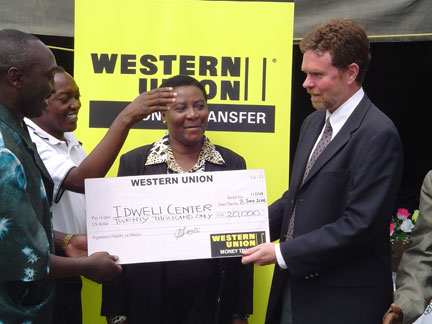
On behalf of the Lundy Foundation, Ambassador Owen accepts a donation from Western Union for project expenses.
June 8, 2005
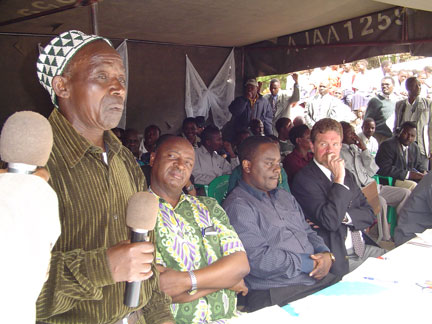
Idweli’s chief encourages villagers to support the center by donating food, time and other resources.
June 8, 2005
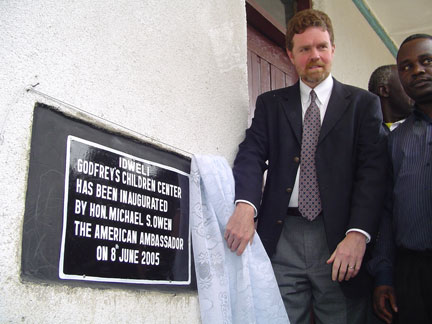
Ambassador Owen unveils the official dedication plaque commemorating the opening of the center.
June 8, 2005
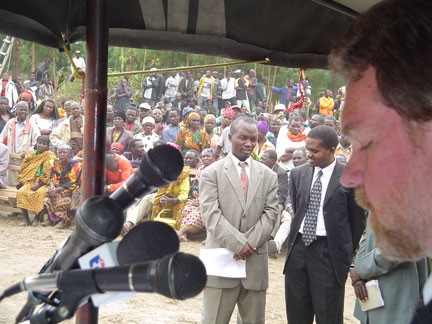
Members of Godfrey’s board listen to Ambassador Owen deliver the dedication speech.
June 8, 2005
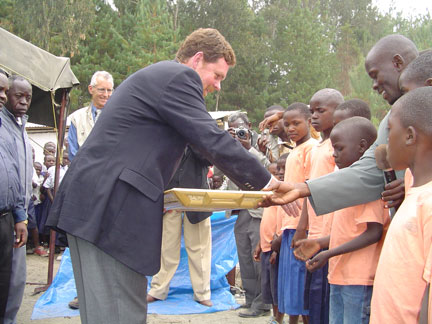
Ambassador Owen accepts a thank-you gift from center children.
June 8, 2005
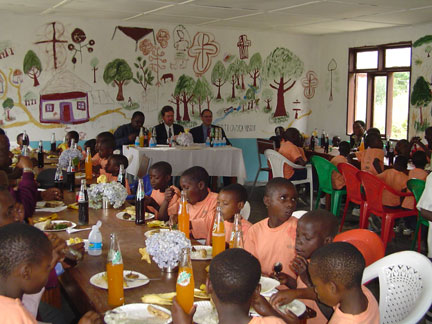
Following the opening ceremonies, center residents shared a meal with the acting U.S. ambassador, a district official and Vic Dukay of the Lundy Foundation.
June 8, 2005
Conquering HIV/AIDS
We Can Stop HIV/AIDS
Our efforts have helped set the stage for a historic opportunity, one that the world has today: to change the course of this pandemic and usher in an AIDS-free generation.
Secretary of State Hillary Clinton
Nov. 8, 2011
In 2010, when the Lundy Foundation joined the collaboration Test & Treat to End AIDS (TTEA), our members were among only a few voices expressing the belief that we had the tools in hand to halt the spread of HIV, the virus that causes AIDS.
After all, since the disease was identified in 1981, the world had poured hundreds of billions of dollars into efforts to stop AIDS. Despite the investment and the 30 million lives lost, there was no vaccine and there was no cure — only millions of new infections each year.
TTEA, however, believed that stopping HIV/AIDS required a total change in the treatment of people who become infected with HIV. Instead of the current practice of waiting to prescribe HIV-fighting drugs only when an individual’s immune system begins to break down (test-and-wait), TTEA pointed to a growing body of scientific evidence showing that immediate treatment reduces the amount of virus a person carries to undetectable levels and makes it 96 percent less likely he or she can infect another person.
TTEA advocated for a large-scale proof-of-concept study of this strategy known as test-and-treat, or treatment as prevention. And in 2011, with TTEA’s urging, then-Secretary of State Hillary Clinton pledged $110 million to fast-track expanded studies of test-and-treat and several other proven prevention strategies in four African countries.
Since then, the Joint United Nations Programme on HIV/AIDS, the World Health Organization and other leading global health organizations have agreed that test-and-treat is currently the most effective strategy to end the epidemic until a vaccine is developed. Widespread adoption of test-and-treat will save lives — and money. Although upfront costs are higher for this strategy because more people will receive HIV-fighting drugs, future costs will drop significantly as those infected live out their lives on treatment and significantly fewer new cases occur.
Today, TTEA has begun the last phase of this initiative: supporting full global implementation of the test-and-treat strategy. Along with other partners, they are exploring a range of funding options, including quantitative easing, to fully fund this humanitarian campaign in 21 African countries.
The Lundy Foundation and TTEA call on other governments, multilateral institutions, the private sector and civil society groups, including faith-based organizations, to help in this unprecedented effort to halt HIV/AIDS and eradicate the disease from the globe.
The goal of an AIDS-free generation, Secretary Clinton said, “may be ambitious, but it is possible [and] would be one of the greatest gifts the United States could give to our collective future.” We couldn’t have said it better.